By Jenny Teichmann
I have been teaching Ancient Greek for a couple of years now and have often heard students complain that Ancient Greek is a difficult language, more difficult than modern languages and even more difficult than the other commonly learned ancient language: Latin. And while I love Ancient Greek, I will also admit that occasionally, in some regards, some of time, well, yes… Ancient Greek does have its challenges.
But why? Why is Ancient Greek so hard? And what can you do to make it less hard? Let’s take a look!
Two Factors
I think there are two factors that make Ancient Greek difficult:
- internal factors (the inherent nature of the language),
- external factors (the way the language is taught and learned today).
Internal Factors
As you certainly know, Ancient Greek has a rather complex grammar. Especially the verbal system can be a bummer, with its…
- three voices (active, passive, middle),
- seven tenses (present, imperfect, aorist, perfect, pluperfect, future, future perfect),
- three numbers (singular, plural, dual),
- three moods (indicative, subjunctive, optative),
- plus various infinitives, imperatives, and participles.
In total, a single Ancient Greek verb can have an awful lot of forms (the number 650 is thrown around on the Internet, but I haven’t done the math myself—feel free to supply your own calculation in the comments, if you like).
Even worse, many (most?) verbs have irregular forms: ἔχω, ἔσχον, ὁράω, εἶδον, λέγω, εἶπον… The list goes on and on. Some even say that irregular is the new normal in Ancient Greek.
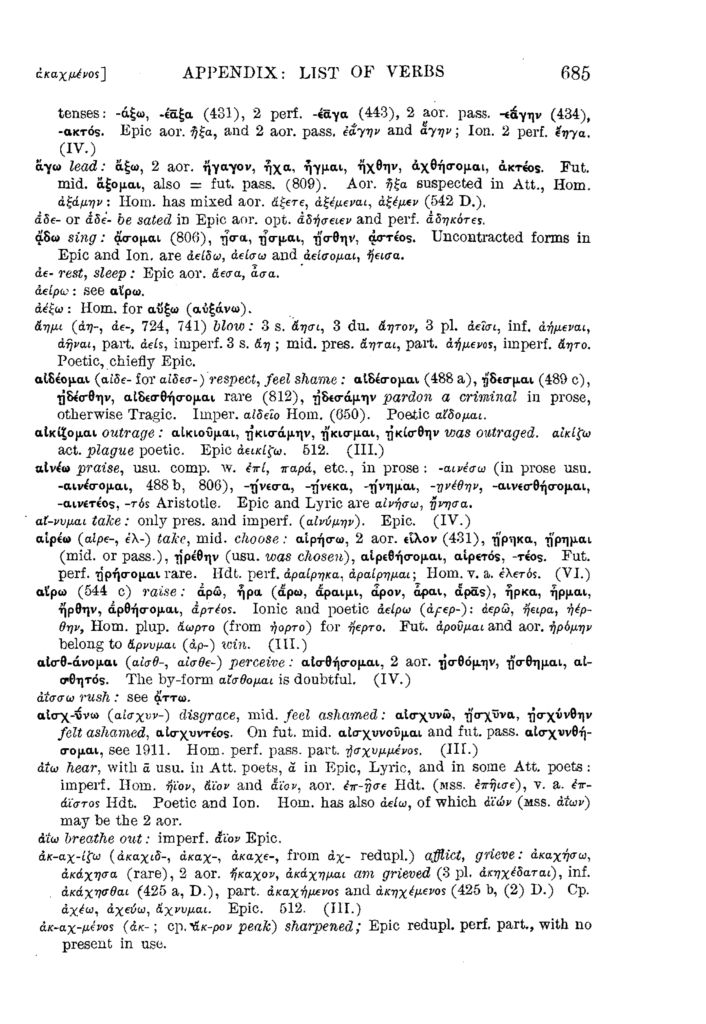
In Smyth’s “Ancient Greek Grammar” you get an exhaustive 40-page overview of irregular verbs:
H.W. Smyth, Greek Grammar for Colleges, 1920, pp. 684-722.
Disclaimer: Trying to memorize the whole list of irregular Ancient Greek verbs might cause a serious drop in self-confidence as well as long-term insanity. If in doubt, contact your philologist of choice before proceeding.
On the plus side, Ancient Greek has only four to five cases (quite an improvement over Latin’s six to seven or Sanskrit’s eight). You need to take what you can get 😊
Now, grammar aside, the Greek vocabulary is also pretty vast. I still regularly encounter new words when reading Ancient Greek, or sometimes the word is familiar but has a different meaning in a given text. Why is that?
Ancient Greek has existed for some 1,200 years (ca. 800 BCE – 400 CE). If we include educated Byzantines like Anna Komnene who continued to write in Ancient Greek (while the spoken language had long evolved and changed already), this time stretch gets even longer. Words, therefore, had a lot of time to shift their meaning or even their grammatical forms.

(Modern depiction of Anna from: Tracey Barrett, “Anna of Byzantium”)
Though living in 12th century Byzantium, Anna Komnene wrote her historical work in Attic Ancient Greek.
So time is one factor that made the Greek vocabulary so vast. Another one is space. Greek was spoken over a large area, which resulted in many different dialects.
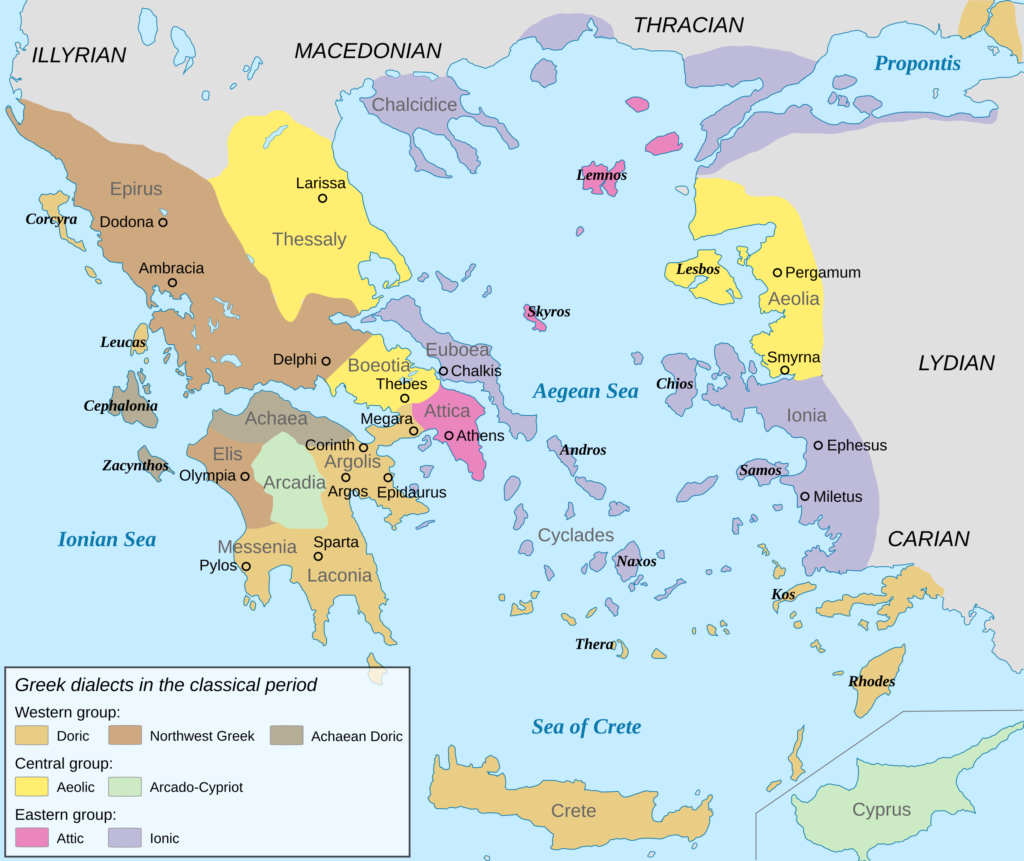
Dialects were not only spoken in different parts of the Ancient Greek world but were also used for certain genres:
- medicine was written in Ionic,
- choral Lyric in Doric,
- early philosophy in Ionic, later one in Attic,
- etc.
And finally, Greek was also used to communicate about many different topics (philosophy, medicine, mathematics, grammar, …), often at a high level of sophistication. Words, therefore, could take on very specific meanings depending on the author or context.
Side Note: Is Ancient Greek THAT Hard, Actually?
I have learned a couple of languages over the years and about almost every single one of them some people said that it is a difficult language (or even the most difficult one there is). How can that be? How can they all be “difficult”?
I would say that each language has some aspects in which it is more or less difficult. Sometimes the grammar is easy but the pronunciation is tough or the spelling is impossible (greetings to you, French).
Also, the “level of difficulty” largely depends on the learner’s background. Learning Polish was really hard for me (being a native German) but it was a walk in the park for my Ukrainian classmate (since Polish and Ukrainian are closely related).
Likewise, learning Ancient Greek will be much easier if you…
- know another inflected language already (like Latin or German),
- have a general knowledge about antiquity (What did people believe in? What were their customs? etc.),
- know modern Greek, especially Katharevousa (the “high brow” standard of Modern Greek which was closely modeled on Ancient Greek examples).
External Factors
So as we have seen, some of its grammar and long history can make Ancient Greek more tricky to learn. However, there is also another big issue: The way Ancient Greek is taught today.
Since Ancient Greek is a “dead” language, it is unfortunately very often taught with a poor methodology. One “traditional” approach is to let students rote memorize vocabulary and grammatical forms and then to translate countless practice sentences that usually make a limited amount of sense (“Having given the letter to the maiden the slave led the horses to the river where he was killed by the general.”). Most people don’t learn well with this kind of approach since it is neither meaningful nor enjoyable.
Another issue is the lack of resources: With modern languages, you can listen to the news, read a forum or watch a movie in your target language. With “dead” languages like Ancient Greek this is much more difficult to do (which is why I created YouTube videos, podcast episodes and booklets in Ancient Greek).
And finally, it is also more difficult to find a practice partner if you want to actually speak the language. The number of Ancient Greek speakers has been growing over the last couple of years, though, so it is totally possible to find a speaker if you want to. One place to start could be online lessons, for example.
How to Make Learning Ancient Greek Easier
So, having admitted that Ancient Greek can be tough at times, what can we do to overcome these obstacles? Here are some tips:
- Focus: Choose only one dialect to learn at first (for example: Homeric Greek, Classical Attic, or biblical Koine); later, you can still expand into other areas
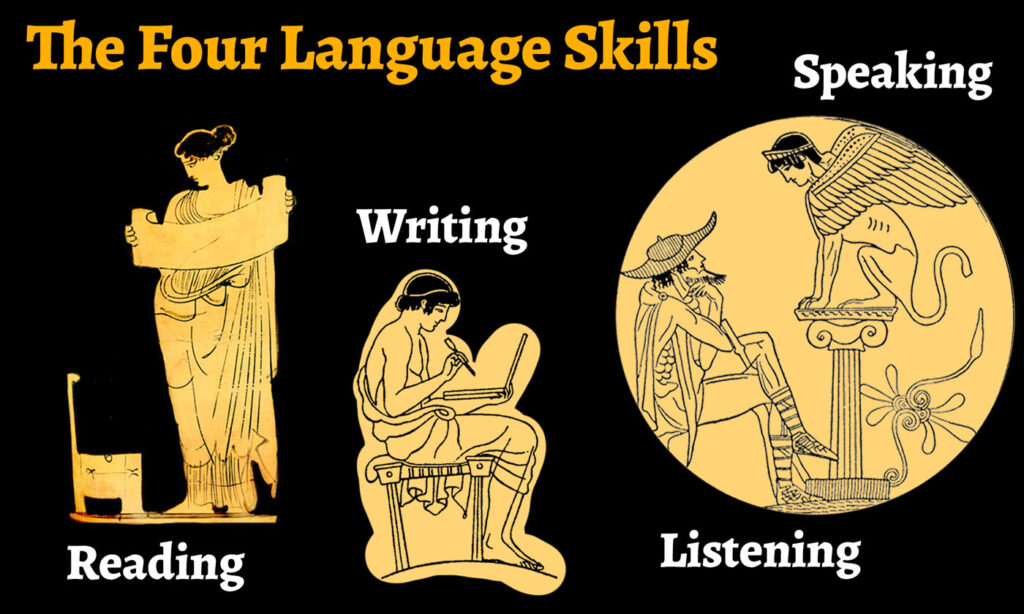
- Use a Wholesome Approach: There are four language skills: listening, speaking, writing, reading. Ancient Greek is often taught through reading alone, which might work for some people, but most learners benefit from practicing all four skills.
- Read Texts You Enjoy: No need to slog through Xenophon’s Anabasis if all you care about is philosophy/poetry/the Bible/…
- Find Grammatical Patterns: I know Greek grammar often seems like a big mess, but at least some of the time there’s a method to the madness—if you can find these patterns, they will reduce your mental load (because you can apply them to new words and don’t have to memorize every possible word form there is).
- Learn in Context: When writing down new words you want to learn, write down also the context in which you encountered them. Human brains are not made to store isolated information but to weave networks. If something is meaningful, moving or funny for you, you will remember it much easier than if it were just a neutral fact.
- Get Some Friends and Mentors: It is fun and motivating to exchange ideas with like-minded people, whether they are a teacher or a friend. Don’t yet have an Ancient Greek buddy? Visit some courses (online or in person) and see if there is somebody you would like to get in touch with. I myself have made some excellent long-term friends this way 🙂
For more ideas on how to learn Ancient Greek, check out this post:
For some easy Ancient Greek texts, check out my suggestions here:



Thank you Jenny! It is very useful and interesting!
Keep blogging!
χάριν σοι ἔχω, ὦ Δημήτριε! 😊