By Jenny Teichmann
I have been studying and teaching Ancient Greek for quite a while now, and sometimes people have asked me (or worse still, I have asked myself):
But why? What’s the point of learning Ancient Greek today?
Because learning a language takes time, and if there is one thing modern humans don’t seem to have, it is, you know… time. (Ironically, the more technology we devise to “help us out”, the less time we seem to have.)
So why do people like me spend our precious, limited lifetime learning and teaching a dead language? I will answer this question from two angles, giving:
- reasons commonly stated by advocates of Ancient Greek,
- my personal, real reasons.
1. Common, Sensible-Sounding Reasons Why to Study Ancient Greek
When teachers of Ancient Greek want to persuade future students (or at least the parents of those students), they come up with arguments like these:
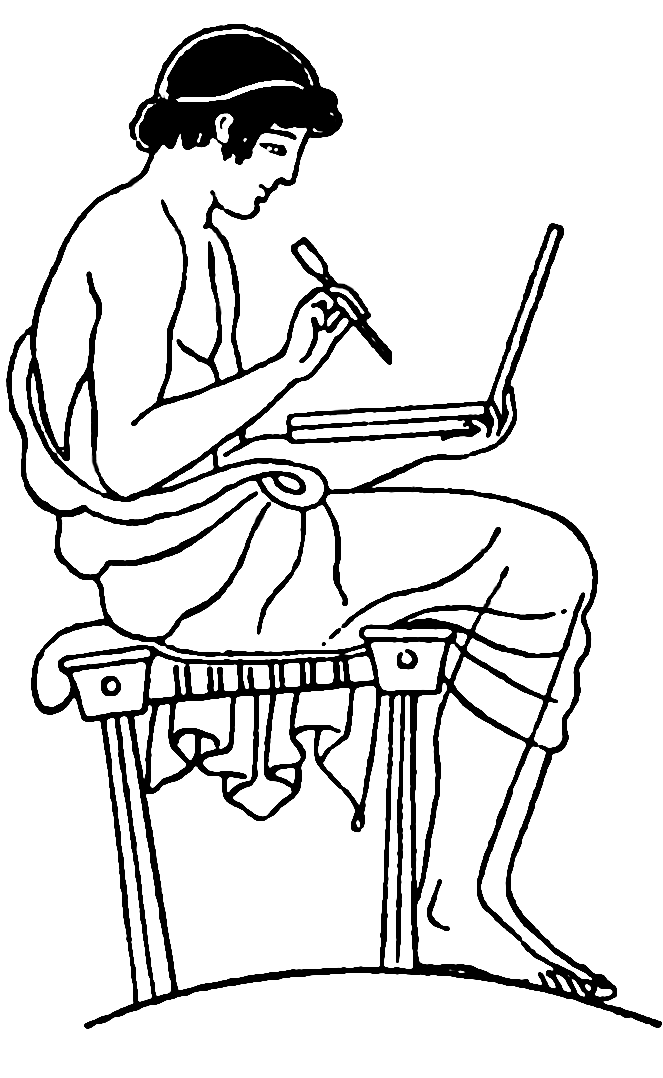
Studying Ancient Greek will…
- sharpen your mind,
- make you a better person,
- connect you with the Western/Christian tradition,
- make you look smart.
Let’s look at these one by one.
α) Ancient Greek will sharpen your mind
Learning Ancient Greek will expand your mind on two levels:
1) Linguistically: Ancient Greek grammar works quite differently from English, so learning this language will give you a new perspective on the human mind and its workings. (This, by the way, applies to learning any new language.)
2) Culturally: Learning about the ancients and their ways of thinking will broaden your understanding of humanity: What it means to be human, which things never change and which do. This is similar to the way travelling abroad expands your horizons, except that learning Ancient Greek is much cheaper and you don’t even have to leave the house.
β) Ancient Greek will make you a better person
This is the good old Renaissance humanism concept of antiquity: a forge for our character, an ideal to emulate, a guide for educating the youth. This view continued all the way into Neoclassicism but might today, I’m afraid, not be very viable anymore. Somehow, we moderns don’t buy into these kinds of “ideals” (having burned our fingers, as it seems, too badly on too many -isms in the 20th century). Still, with the rising mental health crisis and a general feeling of anxiety and aimlessness, maybe a return to the roots, a new renaissance will await us?
“Ad fontes!” (Back to the sources!)
Learning Latin, Greek, and Hebrew to study the bible, acquire knowledge, and become a well-rounded person–this was the educational aim of Renaissance humanists like Erasmus of Rotterdam (1466-1536).

γ) Ancient Greek connects you with the Western (or: Christian) tradition
Probably the most popular argument for learning Ancient Greek today: Greece as the cradle of Western democracy, philosophy, science, arts, medicine, and literature. Whether you want to read Shakespeare or Nietzsche, learn more about the US founding fathers, or the origins of critical thinking–it all goes back to the ancients.
Similarly, if you are Christian and take your bible study seriously, there is no way around learning Koine Greek.
The ancient Greeks invented philosophy (click on the images to enlarge).
(Source: existentialcomics.com)


δ) Ancient Greek will make you look smart
Admittedly, this is a bit of a vanity reason, but still: Ancient Greek has an aura of being difficult, so at least some people will admire your intellect if you dare to study Ancient Greek (while others will deride you for wasting your time on “useless stuff”–well, you can’t please everybody, I guess).
While I applaud (most of) the reasons given above, I doubt that they will convince anybody who wasn’t convinced already. Which brings me to…
2. The Real Reason Why I Study (and Teach) Ancient Greek
The actual, real reason why I started learning Ancient Greek back in the day was… because it was fun. I guess I am a nerdy kind of person, but I always liked languages and I always liked history, so combining these by learning Ancient Greek seemed like a no brainer. Besides, reading the minds (=books) of people who have been dead for millennia is pretty amazing: It is the closest we can get to time travel. I also met some really interesting people (both dead and alive) on this journey. Turns out, students of Ancient Greek are a very smart and nerdy lot; they come from all walks of live and live all over the globe (never would I have thought that teaching Ancient Greek would bring me to New York, Madrid, Prague, Delphi, Shanghai, …).
Now, over a decade after having deciphered my first Greek letters, Ancient Greek just feels like home. Modern times are changing ever faster and faster, and maybe it’s just me getting old, but I do feel that we are losing touch a bit with our basic humanity. For me, the timelessness of Ancient Greek is an antidote to the rushing business of modern life.
And that is why I still study (and teach) Ancient Greek today.